
Offset vs flexographic printing on cups: what’s the difference?
The printing method behind your cups is a decision that happens off-stage, but it shows up clearly on the finished product — in how fine the detail looks, how colours sit, and what the run costs. For custom paper cups there are two methods in play, offset and flexo, and they are matched to your order quantity and your design. Here is what actually changes between offset and flexo, so you can picture the result before you order.
The two methods in plain terms
printing transfers the inked image from a plate onto a rubber blanket, and from the blanket onto the board. That intermediate step lets it lay down very fine, even detail, which is why offset excels at photographic images, smooth gradients and small text. At Nordicup, offset is the usual route for smaller and medium runs.
(flexography) uses a flexible relief plate that prints directly onto the surface — think of a very precise, high-speed stamp. It is efficient and superb at bold, solid colours and clean line work, which makes it a natural fit for logo-led and one- or two-colour designs. At Nordicup, flexo comes into play on large runs.
Detail and image quality
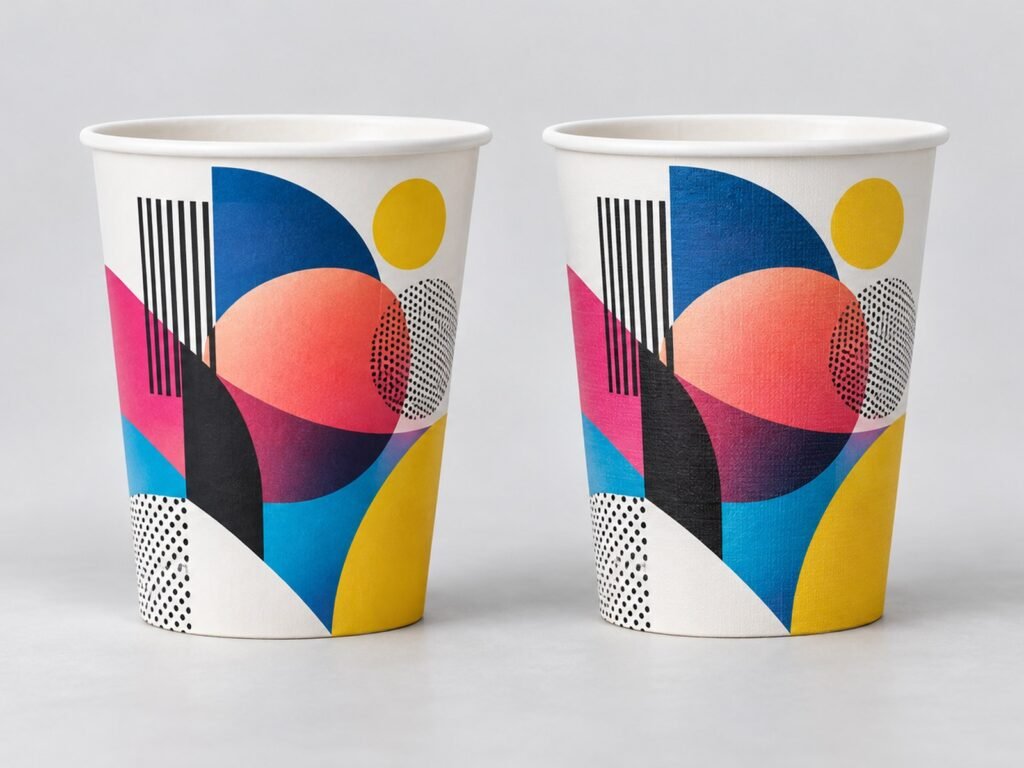
If your design leans on subtle gradients, a full-bleed photograph, or lots of small text, offset is the method that renders it most faithfully. The intermediate blanket step gives it an edge on fine tonal transitions and crisp type at small sizes. Flexo, in turn, is excellent where the design is built from strong, solid areas of colour and confident shapes — a bold wordmark, a two-colour pattern, a clean icon. Neither is “better” overall — they simply suit different kinds of artwork: offset fits a photographic seasonal design, flexo a punchy single-colour logo.
Colour: CMYK versus Pantone
Both methods work with the same two colour approaches. Full-colour CMYK builds every shade from four process inks and suits photographic designs and artwork with many tonal transitions. Pantone spot colours mix a specific ink to a reference, giving the most consistent match for a brand-critical colour — and one- or two-colour printing is often the most economical option too. Whichever you pick, we use food-contact-safe inks and materials, and the cups come with food-contact declarations. If exact brand colour matters more than photographic richness, a Pantone spot on a flexo-printed single-wall cup can be both sharper and cheaper than trying to hit that colour in process CMYK — which matters on the large runs flexo is used for.
Cost: what really drives it
Print method is only one input to price. The bigger drivers are usually the number of colours in your design and the quantity you order. A simple one- or two-colour design in a large flexo run is the economical end of the range. A detailed, full-colour design in a smaller offset run sits at the premium end, and you are paying for the more demanding print and the shorter run. The clean way to think about it: decide the design ambition and the quantity first, and the sensible print method largely follows.
The print method depends on your order quantity
This is the point that saves the most confusion. You do not specify “offset” or “flexo” in isolation — you tell us the quantity and the design, and the method follows:
→ offset. Fine detail, photographic and full-colour artwork reproduced faithfully at the quantities most cafés and brands order.
→ flexo. Bold solid colours and one- to two-colour designs printed at high speed, which is what keeps the unit price down at volume.
So a good early question is not “which printer?” but “what does my design need, and how many cups am I ordering?”
What stays the same either way
Whichever method prints your cups, the fundamentals are constant: food-contact-safe inks, a choice of CMYK or Pantone, artwork placed on a size-specific dieline, the same proof before production (file check, digital proof, written approval — nothing is printed without your confirmation), and production under ISO 9001 and ISO 22000. The method changes the character of the print, but not the care we put into every order.
Not sure which method suits your cups?
Send us your design — a logo is enough — and the quantity you have in mind. We will choose the print method, prepare your artwork free of charge and send you a quote.
FAQ
Offset. Its plate-to-blanket process reproduces gradients, fine detail and small text more smoothly, which is why it is the choice for detailed, full-colour designs.
Yes — flexo prints full-colour CMYK as well, and is outstanding for bold, solid areas and one- to two-colour designs. For finely graded, photographic artwork, offset renders the subtle transitions more faithfully.
Usually you do not need to. We choose the method to suit your order: offset for smaller and medium runs and detailed artwork, flexo for large runs. You only need to settle the design and the quantity; if you have a specific preference, we will discuss it.
Specifying a Pantone spot colour gives the most consistent match to a brand-critical colour, often more precisely and economically than mixing it from process CMYK. Our account manager will confirm the best approach for your palette.
Method matters, but the number of colours and the order quantity usually drive price more. A simple flexo run at volume is economical; a detailed offset run at a smaller quantity sits at the premium end.
Other articles
Single-wall or double-wall — which cup fits?
When the insulating air gap is worth it, in plain language — and when a single-wall cup is the smarter, cheaper choice.
Read →
Getting your artwork print-ready for cups
Vector files, outlined text and the free check before proofing — a plain-language checklist for print-ready custom cup artwork.
Read →
Why custom cup lead times are 2–3 weeks
Where the 2–3 weeks go, stage by stage, when the clock starts, what can stretch the lead time, and how to plan a launch or a repeat order around it.
Read →