
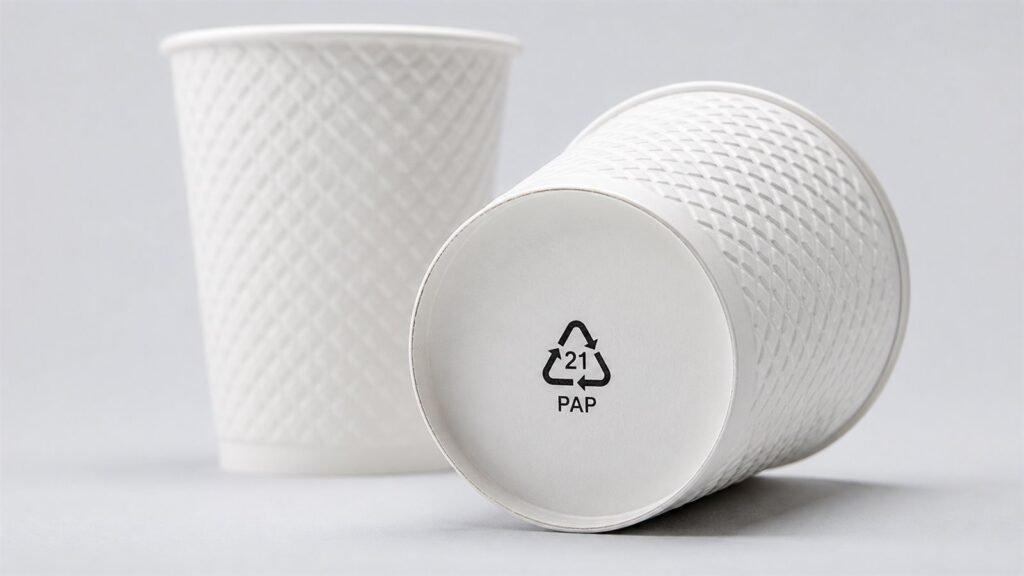
Turn a cold-drink cup over and you will often find a small triangle of arrows with the number 21 and the letters PAP underneath. It looks like a technical marking meant for someone else, but it is worth understanding — especially if you are choosing custom paper cups for a brand that cares how its packaging is sorted and recycled. Here is what the 21 PAP recycling code means, in plain language, and why it appears on Nordicup’s cold-drink bio line.
What the numbers and letters actually mean
21 PAP is part of a Europe-wide system of material identification codes (set out in EU Commission Decision 97/129/EC). The system assigns a number and an abbreviation to common packaging materials so they can be recognised and sorted consistently across countries. Plastics take the familiar numbers 1 to 7, metals sit in the 40s, glass in the 70s — and paper and board occupy the 20s:
- 20 PAP — corrugated cardboard
- 21 PAP — other paper and mixed paper (this is where paperboard cups sit)
- 22 PAP — paper
“PAP” is simply the standard abbreviation for paper. So 21 PAP means the item is classed as a paper-based, mixed-paper product — the correct family for a cup whose body is food-grade paperboard.
Why a cup carries a paper code and not a plastic one
Every cup that holds a cold drink needs a moisture barrier, otherwise the board would go soft. The question is what that barrier is made of, because it changes how the whole cup is classified and recycled.
A conventional cup lines the inside with a thin film of fossil-based plastic (usually PE). That film does its job well, but it means the cup is a paper–plastic composite. The bio line takes a different route: the barrier is plant-based rather than fossil-based, and the cup stays paper-dominant by weight and composition. That is why it can carry the 21 PAP paper code rather than a plastic one — the paperboard is the defining material, and the lining is designed to fit the paper stream rather than fight it.
The “bio” part, without the jargon
“Bio” on a cold cup is shorthand for two related ideas: the barrier comes from renewable, plant-based sources instead of crude oil, and the cup is built to be handled as paper at end of life. In practice that gives you a cold-drink cup that feels and performs like a normal paper cup — sturdy, cool to hold, ready for a lid — but with a lower fossil content and a cleaner recycling story. The same bio approach is what lets the embossed “waffle” cup combine less material with the 21 PAP marking.
One honest caveat: “bio” is not a magic word, and the exact barrier chemistry and any compostability claims should always be read from the material declaration for the specific cup, not assumed. We provide those food-contact and material declarations with every order so your sustainability team can state exactly what they are buying.
What 21 PAP means for how the cup is sorted
For the person finishing their iced coffee, the 21 PAP code is a signal: this belongs with paper, not with mixed plastics. For a waste operator, it identifies the item as mixed paper suitable for fibre recovery at mills equipped to process cups. The fibres in a cup are high quality, and specialised recycling streams increasingly exist to capture them.
The practical reality still varies by country and even by city — not every local kerbside scheme accepts cups yet, and rules change. The value of the 21 PAP marking is that it removes ambiguity about the material, so wherever the right stream exists, the cup can be routed to it correctly instead of being second-guessed at the bin.
Why this matters for your brand
More customers than ever glance at the base of a cup, and procurement and ESG teams increasingly ask suppliers to document material choices. A clearly marked, paper-classified cup lets you talk about your packaging accurately — which is exactly the point. The goal is not to overclaim, but to be able to say plainly what the cup is made of, how it is classified and how it should be disposed of. Getting that right protects you from accidental greenwashing while still telling a genuinely better material story than a fossil-lined cup.
Getting the marking right on your custom cups
You do not have to design or source the recycling symbol yourself. When you order the bio cold-drink or embossed lines, the correct 21 PAP marking and food-contact information are handled as part of production, and we can position recycling and disposal icons within your artwork so they sit tidily alongside your brand rather than cluttering it. Everything is produced under ISO 9001 and ISO 22000, with declarations available on request. If you are weighing up materials, the cold-drink range is the place to start.
FAQ
Is a 21 PAP cup recyclable?
It is classified as mixed paper and is recyclable through paper or dedicated cup streams where those exist. Because local collection rules differ, recyclability in practice depends on the schemes available in your region — the 21 PAP code ensures the material is correctly identified wherever those streams are in place.
What is the difference between 20, 21 and 22 PAP?
They all indicate paper, but at different grades: 20 PAP is corrugated cardboard, 21 PAP is other or mixed paper (where paperboard cups belong), and 22 PAP is paper. The letters “PAP” are constant because they simply mean paper.
Does 21 PAP mean the cup is completely plastic-free?
Not automatically. It means the item is paper-dominant and classed with paper. The bio line uses a plant-based rather than fossil-based barrier; for the precise composition and any compostability claim, read the material declaration for that specific cup, which we supply.
Which Nordicup cups carry the 21 PAP code?
The cold-drink bio line and the embossed “waffle” cup are built around the bio barrier and carry the 21 PAP marking. Ask us which construction fits your drinks and volumes.
Do I have to add the recycling code to my artwork myself?
No. The correct marking is applied as part of production, and we help place any additional recycling or disposal icons neatly within your design.
Want the cleaner material story on your cups?
We’ll walk you through the cold-drink bio and embossed options and send the material declarations your team needs — one specialist, from first question to delivery. Request a quote or explore the cold-drink range.